
Why We Still Have to Explain CSAM in 2026 and What That Says About Our Digital Culture
Illegal images of children circulate widely online, not just on the dark web, but across mainstream platforms. When someone you love is arrested on a Child Sexual Abuse Material (CSAM) charge, the legal terminology arrives fast and without explanation. Statutes, charge codes, mandatory minimums, federal versus state jurisdiction - none of it is written for families, and no one hands you a guide.
Understanding what CSAM means at a foundational level doesn’t change the situation, but it does help families stop drowning in confusion. That clarity is exactly what resources like Support Beyond Stigma aim to provide: trauma‑informed, plain‑language education for people navigating a system that was never designed with them in mind.
This article outlines how federal law defines CSAM, how investigations begin, how charges are categorized, and how state laws, including those covering AI‑generated content, fit into the picture. You don’t need a law degree. You just need to understand what you’re dealing with.
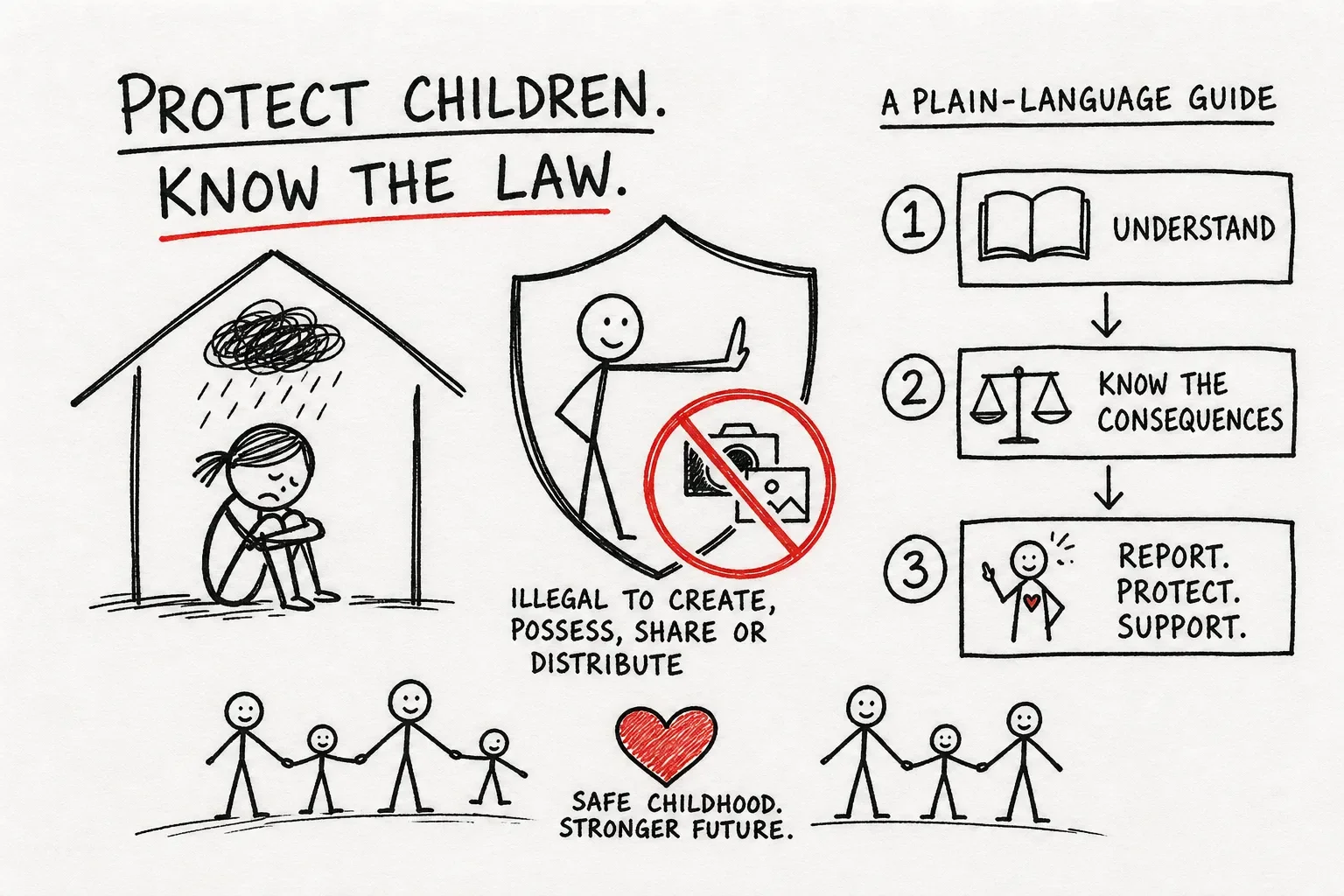
How Federal Law Defines CSAM
The core definition of CSAM lives in 18 U.S.C. § 2256, which establishes the terms used across all federal statutes:
“Visual depiction” includes photographs, videos, digital files, and any other visual medium.
A “minor” is anyone under 18.
“Sexually explicit conduct” is defined in detail, covering specific sexual acts and certain types of posing.
Federal CSAM law is not limited to images of real children being directly photographed. The definition has expanded to include a range of depictions, which is why prosecutions under § 2251, § 2252, and § 2252A all hinge on whether the material meets the § 2256 standard. Coverage of synthetic or AI‑generated images remains a developing area of federal law.
The Department of Justice now uses the term child sexual abuse material instead of child pornography. This shift reflects a victim‑centered approach: CSAM is treated as documentation of abuse, not merely a category of content. That framing shapes how cases are investigated and prosecuted.
How CSAM Investigations Typically Begin
Most families are shocked to learn how law enforcement first becomes aware of suspected CSAM. The answer is almost always platform reporting, not surveillance or tips from acquaintances.
Under 18 U.S.C. § 2258A, electronic service providers including email platforms, cloud storage services, and social media companies must report apparent CSAM to the National Center for Missing and Exploited Children (NCMEC). This is a legal mandate, not a discretionary policy.
When automated systems flag content:
The platform sends a report to NCMEC’s CyberTipline.
NCMEC reviews the submission and determines jurisdiction.
The tip is routed to federal or state law enforcement, often the FBI.
CyberTipline reports account for a large share of online CSAM investigations. This is why arrests can feel sudden to families even when investigators have been working quietly for months.
The REPORT Act recently extended the evidence‑preservation window for CyberTipline submissions from 90 days to one year, giving investigators more time to obtain legal process before platforms can delete flagged content.
The Three Federal CSAM Charge Categories
Federal CSAM charges fall into three distinct categories, each with different penalties and implications.
1. Production — § 2251
The most severe category. Production includes creating or attempting to create CSAM, or inducing a minor to engage in sexually explicit conduct for a visual depiction.
Mandatory minimum: 15 years
Maximum: 30 years
These charges typically involve direct contact with a child, but the statute also covers facilitation and attempted production.
2. Receipt and Distribution — § 2252 and § 2252A
Covers knowingly receiving, transporting, distributing, or accessing CSAM.
Mandatory minimum: 5 years
Maximum: 20 years
“Receipt” often means downloading. “Distribution” can include sharing files, sending links, or making material available through peer‑to‑peer networks.
3. Possession
Possession carries up to 10 years for a first offense and no mandatory minimum. However, prosecutors often charge both possession and receipt based on the same evidence, which can increase sentencing exposure even when the underlying conduct overlaps.
State CSAM Laws and the Rise of AI‑Generated Content
Federal jurisdiction applies whenever interstate commerce is involved, and internet use almost always satisfies that requirement. But states can and do bring their own charges, sometimes alongside federal prosecution. Penalties vary widely.
Between 2023 and 2026, more than a dozen states including Wisconsin, Florida, Pennsylvania, North Carolina, Alabama, California, Texas, South Dakota, Idaho, Tennessee, Georgia, Virginia, Arizona, and Connecticut amended their CSAM statutes to criminalize synthetic or AI‑generated depictions of minors in sexually explicit conduct.
The scope differs by state:
Some require the depicted child to be identifiable.
Others prohibit any realistic synthetic depiction of a minor, regardless of origin.
For families dealing with cases involving digitally altered or computer‑generated material, this evolution is critical. In many states, the absence of a real child does not eliminate criminal liability. Federal coverage of synthetic images is still developing and depends heavily on statutory language and case specifics.
Why Plain‑Language Legal Education Matters for Families
Understanding the CSAM legal framework is not the same as building a defense strategy, that is the attorney’s role. But families are not defendants, and most legal resources are written for lawyers or for the accused. Spouses, parents, and siblings are left to navigate a complex system with little guidance.
Plain‑language education helps families:
Ask better questions of the defense attorney
Have more grounded conversations with their loved one
Make clearer decisions for themselves and those depending on them
Support Beyond Stigma exists to fill this gap. Its educational materials explain CSAM legislation, sentencing, investigations, and related topics in accessible language. Its moderated forum provides community for people facing the same crisis.
If you’re reading this, you’re likely trying to make sense of a legal system that never explained itself to you. CSAM laws are built on clear statutory frameworks. Sentences are severe, mandatory minimums limit judicial discretion, state laws are rapidly expanding to cover synthetic content, and most investigations begin with platform reporting to NCMEC.
Understanding this won’t resolve your situation, but it can replace chaos with clarity and clarity is where families begin to regain their footing.
Disclaimer
This article is for informational and educational purposes only. It does not constitute legal advice, create an attorney‑client relationship, or substitute for consultation with a qualified defense attorney. Laws vary by jurisdiction and change over time; anyone facing CSAM‑related charges should seek guidance from licensed legal counsel.