
SORNA Isn’t the Whole Story: Why Federal vs. State Rules Leave Families Confused
When a loved one is sentenced for a CSAM-related offense, most families assume the legal chapter closes at sentencing. It doesn't. What follows is a decade-long, sometimes lifetime obligation under the Sex Offender Registration and Notification Act (SORNA).
Understanding SORNA registration rules is not optional for any family trying to support someone through reentry. These rules govern where your loved one can live, work, and travel. Getting them wrong can mean federal prosecution and a return to custody.
SORNA registration rules confuse families for good reasons. The law operates on a federal tier system, but each state implements it differently, and the 2021 DOJ final rule added clarifications that most families still haven't heard about. This article covers the tier structure, what must be reported, how federal rules interact with state law, and what noncompliance costs. Support Beyond Stigma (CSAM Support for the Loved Ones of Those Accused) was built to provide exactly this kind of plain-language education for families navigating a legal system that few attorneys explain in full.
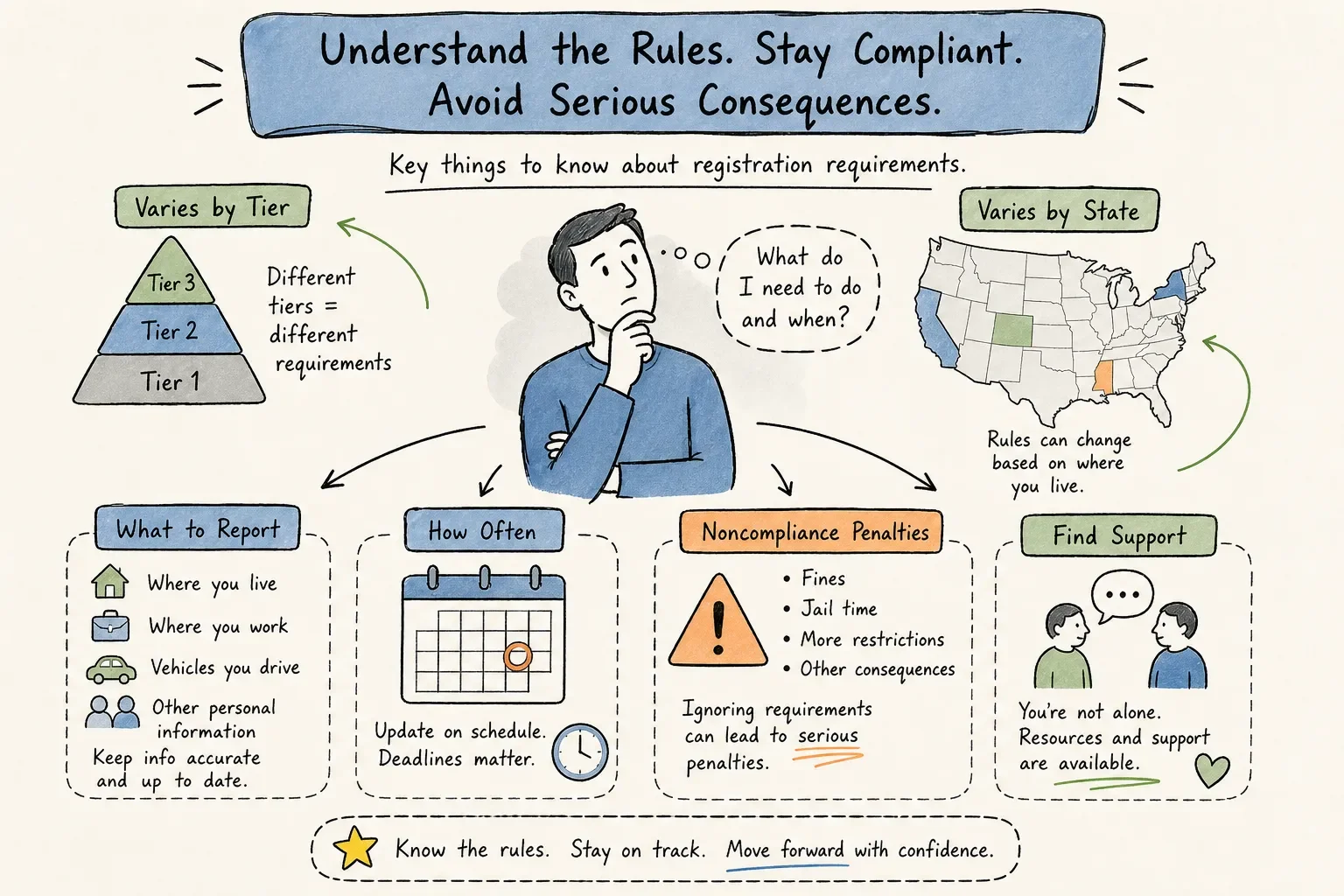
SORNA Registration Rules: How the Three Tiers Determine Length and Reporting Frequency
The single most important thing families need to understand is that SORNA registration is not a one-time event. It is a structured, ongoing obligation assigned according to a three-tier system based on offense severity under federal law. Tiers are determined by offense category under SORNA's statutory framework and DOJ guidance, not by judicial discretion. Many families are surprised to learn this. While state procedures or court processes may affect how removal petitions are handled, a judge cannot simply place someone in a lower tier at sentencing. Some states do not allow removal petitions, and some states do not have tier systems. Yes, it is confusing.
Tier I (least serious) requires registration for 15 years with annual in-person verification. Tier II (moderately serious) requires registration for 25 years with in-person verification every six months. Tier III (most severe) is a lifetime obligation requiring in-person verification every three months.
Under the federal baseline established by the 2021 DOJ final rule, each of those verification appointments must occur in person with the registering authority. Jurisdictions vary in how they administer this requirement, and a small number make limited accommodations in specific circumstances, but the federal standard does not permit phone or online substitution.
There is one exception worth knowing for Tier I registrants. A person with no new convictions, no sex offense violations, and documented completion of an approved treatment program may petition a court to reduce the 15-year registration period to 10 years.
This reduction is not automatic. It requires a formal legal petition, supporting records, and court review. Whether it is available depends on each state’s laws, and some states do not offer any reduction in sex offender registration requirements.
It is not available to Tier II or Tier III registrants, and the procedure varies by state depending on where your loved one is registered.
SORNA Registration Rules: What Must Be Disclosed and Kept Current
Initial registration requires far more than an address. Under SORNA's minimum national requirements, the registrant must actively provide every item on the following list at the time of registration. State implementations may differ slightly in scope or timing, but the federal baseline includes:
Full name and all known aliases
Date of birth
Social Security number
Residential address
Employment information
School enrollment, if applicable
All telephone numbers
Vehicle information, including license plates and storage locations
Passport and immigration documents
Physical description
Current photograph
Fingerprints
This is not a passive background check that the government runs independently. The registrant is responsible for providing every item on that list.
Any change in that information must be reported within three business days. That window applies to changes in name, address, employment, school enrollment, phone numbers, vehicle ownership, and temporary lodging stays of seven nights or more. Some jurisdictions also require reporting of internet identifiers. Three business days is a tight window. Families should understand that administrative oversights, such as a delayed report of a job change, can still create serious compliance risks, including supervision violations or state consequences, even where federal criminal liability under 18 U.S.C. § 2250 typically requires a knowing failure to register.
International travel adds another layer. Under the December 2021 DOJ final rule, a registrant must provide at least 21 days of advance notice before any international travel, regardless of how brief the trip is. The rule does include limited accommodations for genuine emergencies, but the default requirement is firm. If your family is planning any international travel that includes your loved one, formal notification to the registration authority must be the first step, not an afterthought.
What the 2021 DOJ Final Rule Actually Clarified
The December 2021 DOJ final rule did not create a new registration system from scratch. It codified SORNA's minimum national requirements, making explicit what jurisdictions had previously interpreted differently. The rule confirmed that a sex offender must register, and keep registration current, in every jurisdiction where the person lives, works, or attends school. Someone who lives in one state and commutes to a job in another may have registration obligations in both states at the same time.
The rule also clarified the timing of initial registration. If a prison term is imposed, registration must occur before release. If no prison term is imposed, registration must occur within three business days of sentencing. Families who assume there will be time to sort things out after sentencing are often wrong.
Perhaps the most critical clarification in the 2021 rule is this: the federal duty to register exists independently of state law. A person can be prosecuted under 18 U.S.C. § 2250 even if the state where they reside has not fully implemented SORNA or operates under different timelines. A non-compliant or partial-compliance state law is not a shield against federal prosecution. Families sometimes encounter conflicting information online and assume that if their state doesn't require something, they're in the clear. That assumption is legally dangerous.
Why the Rules Look Different Depending on Which State Your Loved One Lives In
As of the SMART Office's most recent published implementation review, only 18 states have been found to substantially implement SORNA. Those states are Alabama, Colorado, Delaware, Florida, Kansas, Louisiana, Maryland, Michigan, Mississippi, Missouri, Nevada, Ohio, Oklahoma, South Carolina, South Dakota, Tennessee, Virginia, and Wyoming. Readers should check the DOJ SMART Office's implementation-status page for the current snapshot, as this list is updated periodically. The remaining 32 states have not yet met that threshold, but that does not mean registration requirements disappear in those states. It means those states have not fully aligned their own laws with the federal baseline.
The four areas where states most commonly fall short are consistent across federal reviews: which offenses trigger the duty to register, how quickly registrants must report changes, in-person verification frequency, and public registry website standards. Even within the 18 compliant states, "substantial implementation" does not mean identical laws. States can exceed the federal floor, and many do.
If a state has not substantially aligned with or implemented SORNA, the individual's duty to comply with federal law still depends on following the local state registration procedures available in that jurisdiction.
SORNA itself does not mandate specific residency distances or employment restrictions. However, nearly every state layers its own rules on top of the federal requirements. Residency restrictions near schools, parks, day cares, and playgrounds range from 500 feet in some states to 2,000 feet in others. Employment near child-focused locations is restricted in most states through distance rules, occupational bans, or both. These state-specific restrictions are not uniform, and they must be researched for the specific state where your loved one will reside before reentry, not after.
The Real Consequences of Failing to Register or Update
Knowingly failing to register or update a registration under SORNA is a federal felony. Under 18 U.S.C. § 2250, the penalty is up to 10 years in federal prison and fines up to $250,000. If the failure occurs alongside a federal crime of violence, SORNA adds a mandatory sentence of five to thirty years. Federal jurisdiction most commonly attaches when interstate or foreign travel is involved, a low bar given how routinely people cross state lines.
State Penalties Are Separate and Independent. SORNA requires states to set maximum penalties above one year for registration failures, and states prosecute these violations on their own timeline, independent of any federal action. State prosecution timelines are not bound by the resolution of any federal case. A single failure to update could theoretically result in both federal and state prosecution simultaneously.
For individuals on federal supervised release or probation, the stakes are even more immediate. SORNA compliance is a mandatory condition of supervision. A registration lapse, even a technical one, is grounds for revocation, meaning a return to custody is possible without a new criminal charge being filed. Families supporting someone through supervised release need to treat registration deadlines with the same seriousness as court appearances.
How Families Can Prepare for the Long Road Ahead
Before reentry, families need concrete answers to a specific set of questions. Which state will your loved one reside in, and does that state have its own residence or employment restrictions beyond federal requirements? What tier has been assigned, and what does the corresponding verification schedule look like in practical terms? Who is the local registration authority, and what is the process for initial registration? These are not details that can wait until after release. Getting any one of them wrong at the start can trigger the consequences outlined above.
Working with a qualified defense attorney, particularly one familiar with SORNA and sex offender registration requirements in the relevant state, is not a step that families should skip. The stakes of an uninformed reentry are too high. An attorney can review the tier assignment, identify applicable state restrictions, and help your loved one establish a compliant registration plan before release.
SBS (Support for Loved Ones of the Accused) was built for exactly this moment in a family's journey. The SBS learning center provides plain-language educational resources on sex offender registration requirements, the reentry process, supervised release, and the federal legal framework, all in a trauma-informed environment designed for families, not attorneys. The forum is manually moderated and requires member verification to help maintain a genuinely private space. For families navigating this without peer support, SBS offers both the information and the community that make these challenges more manageable. You can reach the platform through its secure contact form if you aren't ready to join the forum yet.
The Obligations Don't End, but the Confusion Can
SORNA registration rules are not a short chapter in your loved one's story. They are a decade-long or lifetime obligation that shapes where they can live and work, how far they can travel, and how frequently they must appear in person to verify their information. For families trying to help someone rebuild a life, understanding these rules is not about fear. It is about preventing a legal misstep from undoing years of progress.
The most important steps are straightforward: research the specific state's implementation, consult a qualified attorney about tier assignment and local restrictions, and build a compliance calendar that treats every update deadline as non-negotiable. The federal duty to register exists independent of what any state law says, and the penalties for failure are severe.
Frequently asked questions about SORNA registration rules
How often must my loved one update their registration under SORNA registration rules?
The update frequency depends on the assigned tier. Tier I registrants verify annually, Tier II every six months, and Tier III every three months. Beyond scheduled verifications, any change in name, address, employment, school enrollment, phone numbers, vehicle ownership, or lodging stays of seven nights or more must be reported within three business days.
Does living in a state that hasn't fully implemented SORNA offer any protection from federal prosecution?
No. The federal duty to register under 18 U.S.C. § 2250 exists independently of state law. Residing in a state that hasn't substantially implemented SORNA does not eliminate the federal obligation or shield against federal prosecution for a knowing failure to register. However, there is no independent place to register federally.
State registration is the only mechanism: the federal government relies on state and local agencies to collect and maintain registry data. If a state has not substantially aligned with or implemented SORNA, the individual's duty to comply with federal law still defaults to following the local state registration procedures.
Can a judge reduce my loved one's registration tier at sentencing?
Under SORNA's statutory framework and DOJ guidance, tiers are assigned based on offense category, not judicial discretion at sentencing. State court processes may affect how removal petitions are handled later, but tier assignment at the time of conviction is offense-driven. A qualified attorney can advise on any petition options available in the relevant jurisdiction.
Where can I find out whether my state has substantially implemented SORNA registration rules?
The DOJ's SMART Office publishes and periodically updates an implementation-status list on its website. As of the most recent review available, 18 states have been found to substantially implement SORNA. Check the SMART Office site directly for the current list and date of the most recent review.
You don't have to figure this out alone. SBS exists to provide the education and community support that families navigating sex offender registry requirements too rarely find. Knowing the rules is the first step. Having a community that understands the process removes one more obstacle from an already difficult road.
Disclaimer
This article is for informational and educational purposes only. It does not constitute legal advice, create an attorney‑client relationship, or substitute for consultation with a qualified defense attorney. Laws vary by jurisdiction and change over time; anyone facing CSAM‑related charges should seek guidance from licensed legal counsel.